Table of Contents
- What Is the Nepal Labor Act 2074?
- Types of Employment Under the Act
- Probation, Working Hours & Overtime
- Probation period
- Working hours
- Overtime rules
- Minimum Wage in Nepal (Updated for 2083)
- Employee Leaves in Nepal
- SSF Contribution Explained
- Resignation & Termination
- Sexual Harassment, Grievance & Internal Policy
- Compliance Checklist for Employers (2083)
The Nepal Labor Act 2074 (2017 AD) is the cornerstone of every employment relationship in the country. Whether you run a five-person startup in Patan or manage HR for a 500-employee enterprise in Kathmandu, this is the law that governs how you hire, pay, leave, promote, discipline, and exit every worker on your roll.
This guide breaks down the Act in plain English - what it says, how it has been clarified through circulars and the Labor Rules 2075, and what employers need to know to stay compliant through 2083 BS (2026-27 AD).
What Is the Nepal Labor Act 2074?
The Nepal Labor Act 2074 replaced the older Labor Act 2048 (1992) and modernised Nepal's employment framework. It came into force on Bhadra 19, 2074 BS (4 September 2017) and is implemented through the Labor Rules 2075.
Three things make it different from the law it replaced:
Universal coverage. It applies to every enterprise with one or more employees, not just companies with 10+ workers as the old Act required. Most family-run shops, small offices, and growing startups are now squarely inside the law.
Mandatory social security. It introduced compulsory enrolment in the Social Security Fund (SSF), which absorbed Provident Fund, Gratuity, and Medical/Accident insurance into a single integrated contribution system.
Flexible employment categories. It recognised contract-based, work-based, and part-time employment alongside regular employment - but with clear rules on each, so misclassification is no longer a grey area.
If your business is not yet fully aligned with the 2074 Act, you are exposed during a Labor Office inspection, an employee grievance at the Labor Court, or a workforce audit. For a side-by-side view of the Nepali HRMS platforms that bake these rules into the day-to-day workflow, see our HRMS comparison guide.
Types of Employment Under the Act
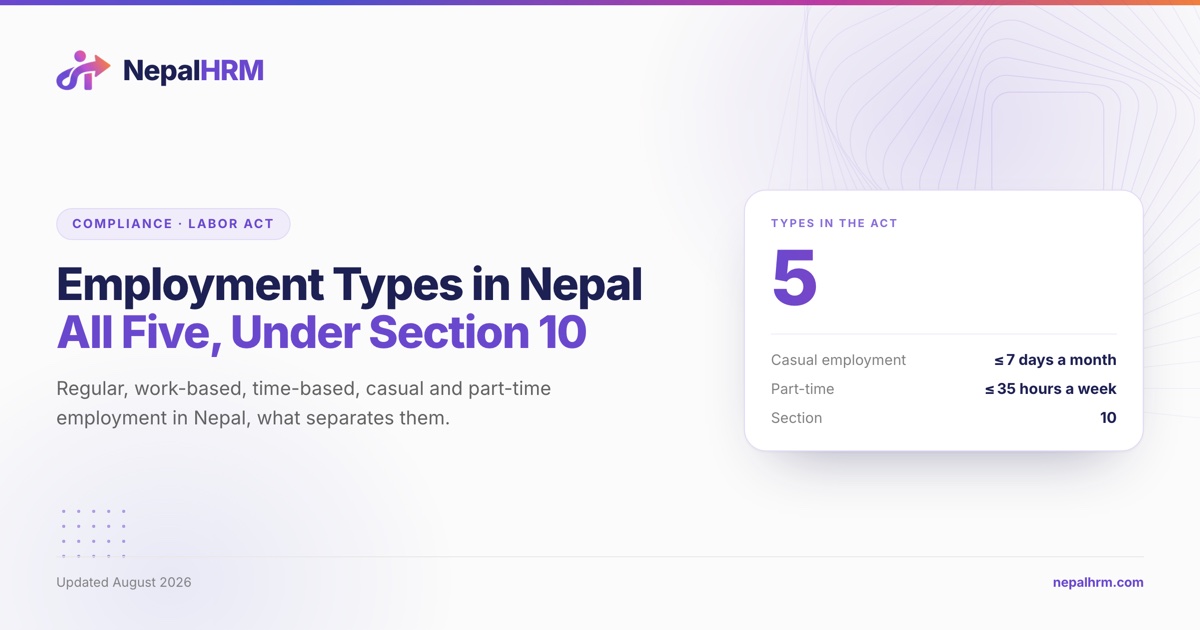
The Act recognises five categories of employment. Every offer letter you issue should clearly state which one applies.
Regular employment - open-ended; the default for most full-time roles.
Work-based employment - tied to a specific project; ends when the work ends.
Time-based employment - fixed-term contract for a defined period.
Casual employment - fewer than seven days of work in a month.
Part-time employment - fewer than 35 hours per week on a regular basis.
Misclassifying a regular employee as "casual" or "contract" is one of the most common compliance failures the Labor Office flags during audits - and one of the easiest to fix with a proper HR system that issues consistent appointment letters.
Probation, Working Hours & Overtime
Probation period
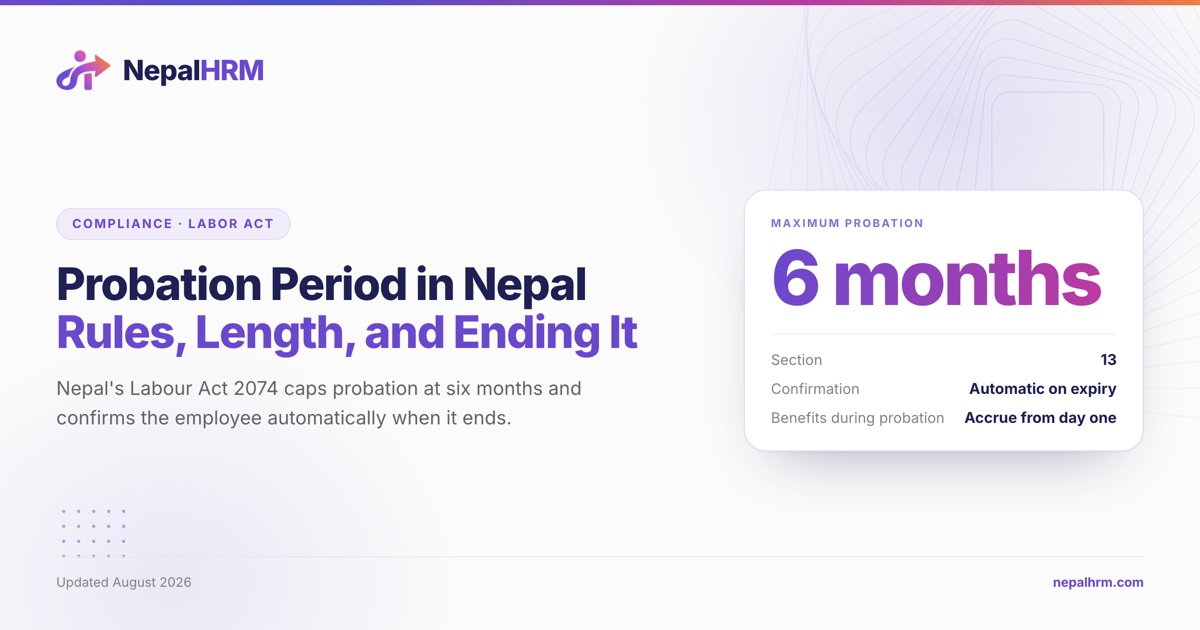
A probation period can last up to six months. During probation, either side can end the employment with shorter notice (or pay in lieu of notice). After six months, the employee is automatically confirmed as regular - even if no formal confirmation letter is issued. Many disputes start here: HR forgets to issue confirmation, the Labor Court treats the employee as regular anyway, and termination later requires the full procedure.
Working hours
The Act sets working hours at:
8 hours per day
48 hours per week
One full day of weekly leave (typically Saturday)
Overtime rules
Overtime is allowed but tightly capped:
Maximum 4 hours per day
Maximum 24 hours per week
Paid at 1.5× the regular hourly wage
Cannot be made compulsory beyond the legal cap
Many employers in Nepal still informally roster employees for "10 to 7" without separating regular and overtime hours on the payslip. That is non-compliant. Time-tracking software like NepalHRM computes overtime accurately for each pay cycle and feeds the result into a Nepal-ready payroll engine so the payslip holds up under inspection.
Minimum Wage in Nepal (Updated for 2083)
The minimum wage in Nepal is set by a tripartite Minimum Wage Committee (government, employers, trade unions) and is typically revised every two years.
The current minimum monthly wage, effective from Shrawan 2080, is:
Component | Amount (NPR) |
|---|---|
Basic salary | 10,820 |
Dearness allowance | 6,480 |
Total monthly minimum | 17,300 |
Daily minimum | 668 |
Hourly minimum | 89 |
The Committee is expected to revise these figures again before the end of 2083 BS. Once a new rate is gazetted, it applies from the date stated in the notification - back-pay is not optional. Employers should track the Department of Labor's official notices and update their payroll the same pay cycle the revision takes effect.
Employee Leaves in Nepal
The Act guarantees several types of paid leave. The combined entitlement is one of the more generous in South Asia.
Leave type | Entitlement | Paid? |
|---|---|---|
Weekly leave | 1 day per week | Yes |
Public / festival leave | 13 days per year | Yes |
Home leave (annual leave) | 1 day per 20 days worked (~18/yr) | Yes |
Sick leave | 12 days per year | Yes |
Mourning leave | 13 days | Yes |
Maternity leave | 98 days (60 paid) | 60 days paid |
Paternity leave | 15 days | Yes |
Substitute leave | 1 day for each holiday worked | Yes |
Unused home leave can accumulate up to 90 days and must be encashed when an employee leaves the company. Sick leave does not encash but can be carried forward up to 45 days.
Maternity leave is paired with SSF maternity benefits for enrolled employees - eligible mothers receive a cash benefit on top of the leave entitlement. Employee leaves Nepal rules are one of the most common areas where small businesses fall behind, mostly because they rely on memory and spreadsheets instead of an actual leave register. The NepalHRM Free plan is free for up to 10 employees and keeps a per-employee leave ledger out of the box.
SSF Contribution Explained
The Social Security Fund (SSF) is the centrepiece of Nepal's modern labor compliance framework. Enrolment is mandatory for every enterprise covered by the Act.
The total monthly SSF contribution is 31% of basic salary:
Employee contribution: 11%
Employer contribution: 20%
The contribution is allocated across four protection schemes:
Scheme | Allocation |
|---|---|
Medical, health & maternity protection | 1.00% |
Accident & disability protection | 1.40% |
Dependent family protection | 0.27% |
Old age protection (PF + gratuity replacement) | 28.33% |
Old Age Protection effectively replaces the older split between Provident Fund and Gratuity for SSF-enrolled enterprises. Once an employee completes the required contribution periods, they qualify for pension, retirement lump-sum, or survivor benefits.
Filing deadlines are strict. SSF returns and contribution payments are due by the 15th of every month for the previous month's salary. Late filing attracts interest and penalty - and repeated non-compliance can suspend the firm's good-standing certificate.
Resignation & Termination
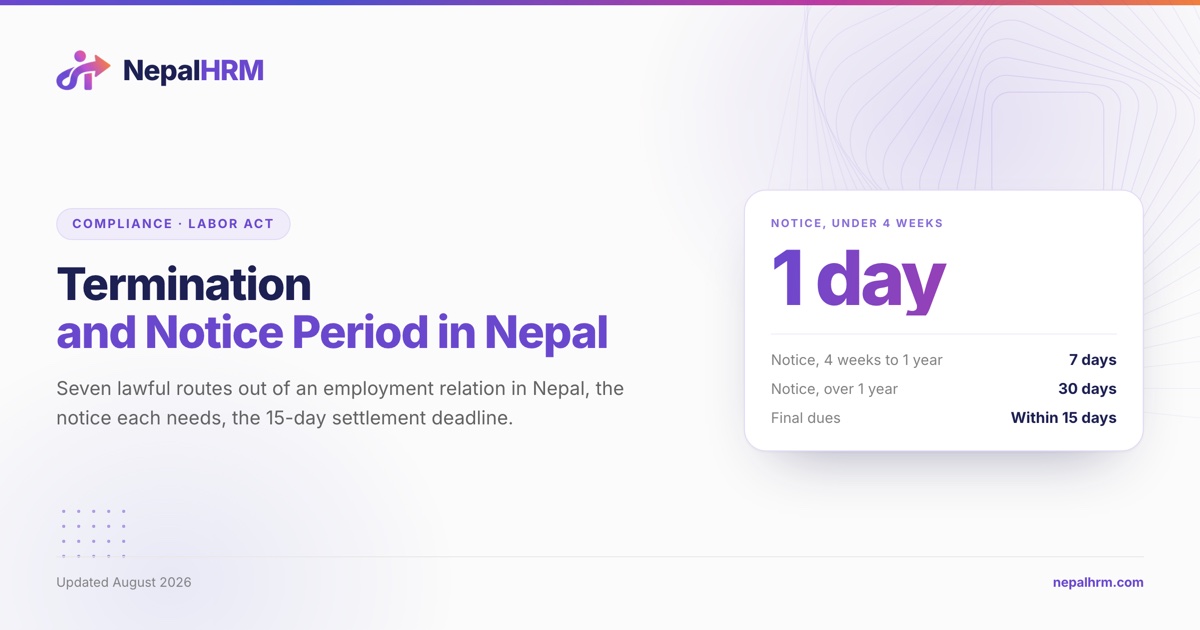
Employees who resign must give 30 days' written notice or pay the equivalent salary in lieu. Employers terminating a regular employee must do the same - plus document a valid reason and follow the disciplinary procedure laid out in the Act.
Grounds the Act recognises for termination include:
Continued under-performance after written warnings and a documented improvement plan
Misconduct established through inquiry (theft, harassment, repeated insubordination)
The position becomes redundant due to a genuine business restructuring
A health condition that makes the role untenable, established through medical assessment
Wrongful or undocumented termination is the single most expensive mistake Nepali employers make. The Labor Court routinely orders reinstatement plus back-pay when an employer cannot produce a clean paper trail. Keep written warnings, performance reviews, inquiry minutes, and the final termination letter on file for at least three years.
Sexual Harassment, Grievance & Internal Policy
Every enterprise covered by the Act must maintain a written internal HR policy and a grievance redressal mechanism. Larger enterprises are also required to have a sexual harassment prevention policy compliant with the Sexual Harassment at Workplace Prevention Act 2071.
Practical minimum standards:
A written employee handbook covering working hours, leaves, salary structure, code of conduct, and disciplinary procedure
A designated grievance officer or committee
A documented complaint and inquiry process with clear timelines
Annual policy review and employee acknowledgement on file
Compliance Checklist for Employers (2083)
A practical checklist to keep your business on the right side of labor law updates Nepal rolls out through 2083:
Every employee has a signed appointment letter stating employment type, salary breakdown, and notice period
Working hours are tracked daily; overtime is calculated and paid separately at 1.5×
Minimum wage is reviewed every pay cycle against the latest gazette notification
SSF is enrolled, contributions are filed by the 15th of every month
Leave records are maintained in a register or HR system; balances are visible to employees
Termination always follows a documented inquiry + 30-day written notice
Internal HR policy / employee handbook is updated to reflect the current law
Sexual harassment policy and grievance procedure are in writing and visible to all staff
Personnel files retained for at least three years after exit