SSF Contribution Calculator: 11% + 20% = 31%
Enter a basic salary and read the employee, employer and total Social Security Fund contribution for Nepal, monthly and yearly, with the split that appears on the payslip.
- Assessed on basic salary
- No sign-up
- Monthly and yearly
Nepal SSF rates
- Employee, deducted from pay
- 11%
- Employer, paid on top
- 20%
- Total deposited each month
- 31%
- Assessed on, not gross
- Basic
SSF contributions are calculated on Basic salary, not Gross. The employer's 20% is paid in addition to the salary and does not reduce the employee's take-home pay. Figures are a flat-rate estimate with no monthly ceiling applied. A payroll run in NepalHRM applies the ceiling set in payroll settings and the exact per-employee rules.
One Number In, The Whole Split Out
SSF is assessed on the basic component of a Nepali salary, so the only input that matters is basic. Everything else follows from it.
- 1
Start from basic, not gross
Take the basic component of the salary, not the full gross. If your structure is 60% basic, a gross of NPR 50,000 gives a basic of NPR 30,000, and that is what SSF is charged on.
- 2
Enter the monthly basic
Type it in or drag the slider. The three figures update as you move, so you can see what a salary revision does to the contribution before you commit to it.
- 3
Read the 11% / 20% / 31% split
The employee's 11% is deducted from the salary and reduces take-home. The employer's 20% is paid on top and does not. Together they are the 31% deposited to the fund.
- 4
Check the annual cost
The yearly row is the number to budget with, and the one to compare against PF + CIT when deciding which scheme to enrol in.
Last updated · Reviewed by Rajendra Regmi, Co-founder
Who Pays What into the Social Security Fund
Three lines, all charged on the basic component of the salary and deposited together each month.
| Contribution | Rate on basic | Where it comes from |
|---|---|---|
| Employee share | 11% | Deducted from the salary, so it lowers take-home pay |
| Employer share | 20% | Paid on top of the salary, so it does not touch take-home pay |
| Total to SSF | 31% | Deposited to the fund every month by the employer |
PF + CIT is the alternative scheme: 10% employee and 10% employer to the Provident Fund, plus a voluntary CIT contribution. An employer runs one scheme or the other, never both, and staff under SSF are exempt from the 1% social security tax on the first income band.
Six Things People Get Wrong About SSF
SSF stands for Social Security Fund
सामाजिक सुरक्षा कोष, the state scheme set up under the Contribution Based Social Security Act 2074. An enrolled employer deposits a contribution for every enrolled employee each month, against a social security number issued to that employee.
11% employee, 20% employer, 31% in total
The employee's 11% is deducted from their salary. The employer's 20% is paid on top of it, so the combined 31% of basic salary is what reaches the Fund. Only the 11% is a deduction; the 20% is a cost of employment.
Charged on basic, not on gross
A Nepali salary structure splits gross pay into Basic and Allowance, and SSF is assessed on the Basic component. On a NPR 30,000 basic that is NPR 3,300 from the employee and NPR 6,000 from the employer, NPR 9,300 a month in total, whatever the allowances add on top.
Take-home falls by the 11%, and only the 11%
The employer's 20% never passes through the employee's payslip, so it does not reduce net pay. An employee on a NPR 30,000 basic sees one SSF line of NPR 3,300, plus TDS if their income is taxable.
It replaces PF and CIT, it does not stack on them
A company runs one retirement scheme. An employee enrolled in SSF has no separate Provident Fund deduction: the 11% and 20% take the place of the 10% + 10% PF and the CIT contribution a non-SSF employee would run instead.
SSF contributors skip the 1% social security tax
The first income-tax band in Nepal is a 1% social security tax. An SSF contributor is exempt from it, because the SSF contribution already covers what that 1% funds. Every band above the first is charged exactly as it is for anybody else.
SSF on Every Payslip, Without the Spreadsheet
This page works out one contribution. NepalHRM works out all of them, every month, and keeps the record the fund and your accountant will ask for.
- PF, CIT and SSF deductions are set once in payroll settings and applied to every employee on every run.
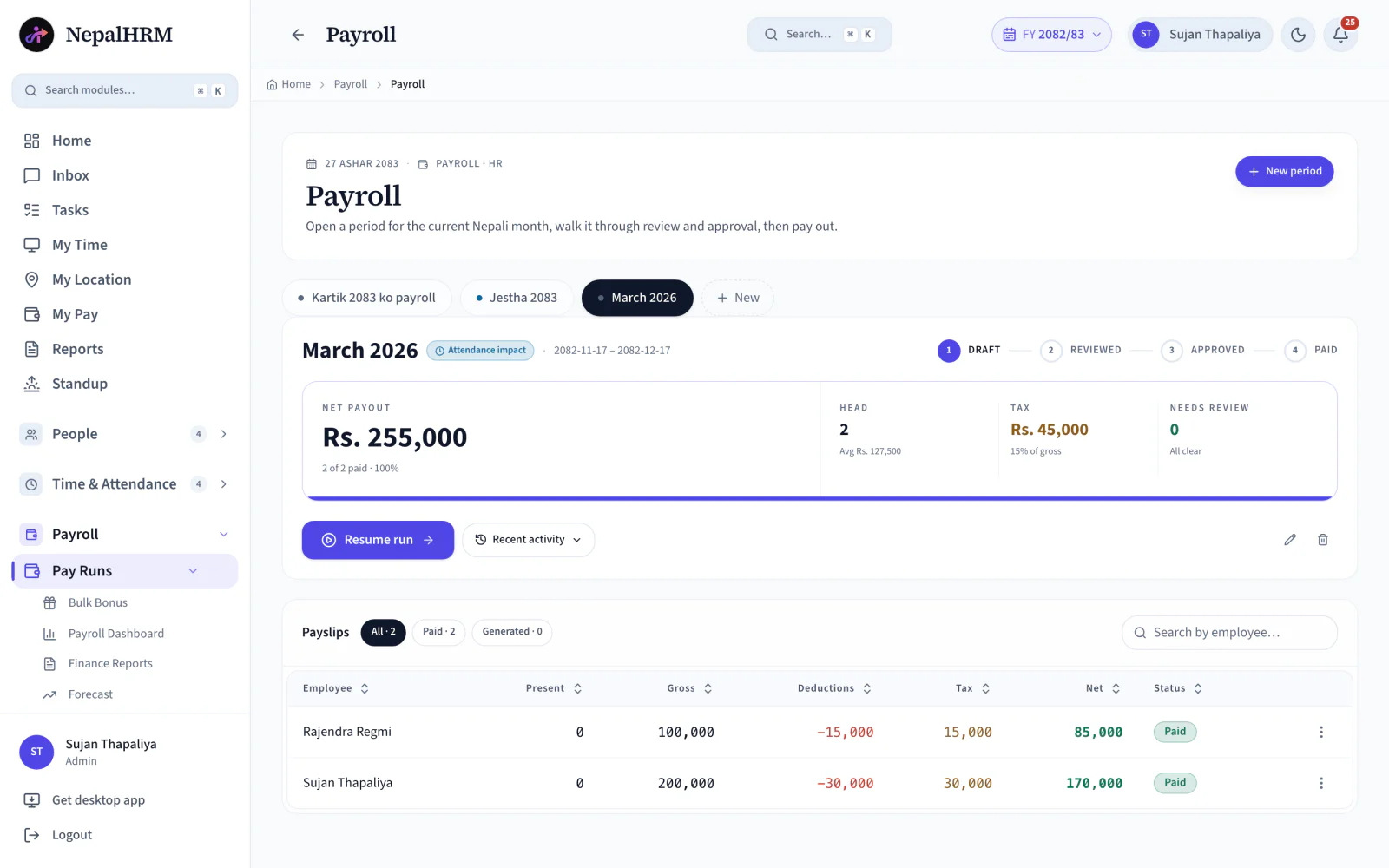
- Each payslip shows the employee contribution as a deduction and the employer contribution separately.
- Salary sheet and finance reports come out of the same run, so the deposit figure is not retyped.
- Periods follow the BS fiscal year, so the contribution history lines up with the year you report on.
Nepal Social Security Fund, Explained
SSF stands for Social Security Fund (सामाजिक सुरक्षा कोष), Nepal's contribution-based social security scheme. Employers register with the Fund, enrol their staff, and deposit a monthly contribution for each enrolled employee under the Contribution Based Social Security Act 2074.
The Social Security Fund contribution is 31% of the employee's Basic salary: 11% deducted from the employee and 20% contributed by the employer on top of the salary. The combined 31% is deposited to the SSF each month.
11% of Basic salary. On a NPR 20,000 basic that is NPR 2,200 a month, on NPR 30,000 it is NPR 3,300, and on NPR 50,000 it is NPR 5,500. The employer separately deposits 20% of the same basic, which is not taken out of the employee's pay.
On Basic salary. Nepali salary structures split gross pay into Basic and Allowance, and the 11% + 20% SSF contribution is assessed on the Basic component, not the full gross.
No. The employer's 20% is paid in addition to the salary and does not come out of the employee's pay. Only the employee's own 11% is deducted from their salary; the take-home is reduced by that 11% (plus any TDS).
One or the other, never both. A company enrolled in the Social Security Fund deducts 11% SSF and contributes 20%, and those employees carry no separate Provident Fund line. A company outside the scheme runs the older 10% employee plus 10% employer PF, usually with a CIT contribution alongside it.
Yes, in two ways. An SSF contributor is exempt from the 1% social security tax charged on the first income band, and the contribution itself reduces taxable income within the statutory retirement relief, which is the lowest of the actual contribution, NPR 500,000 a year, or one third of assessable income.
An employee of a registered, enrolled employer who has been listed with the Fund and issued a social security number. Enrolment is the employer's job: the company registers with the SSF first, then enrols each employee, and contributions run from the month that employee is listed.
The Social Security Fund provides schemes covering medical treatment, health and maternity, accident and disability, dependant/family protection, and old-age pension for enrolled contributors, per the Contribution Based Social Security Act.
From the Social Security Fund's own member channels, not from an HR system. What NepalHRM shows is the employee's side of it: the 11% deduction on every payslip, the employer's 20% recorded against the same month, and the running total for the fiscal year.
No. This is a quick estimate at a flat 11% and 20%, so on a very high basic salary it reads higher than a real payroll run. NepalHRM applies the monthly SSF contribution ceiling set in your payroll settings, caps the employee and employer shares together, and scales the base down for unpaid days before applying it.
NepalHRM calculates the 11% employee and 20% employer SSF on each employee's basic automatically every payroll run, shows it on the payslip, and prepares the deposit figures. No spreadsheets. You can try it free for up to 10 employees.
While You're Here, Try These Too
Every NepalHRM tool is free, runs in your browser and needs no account. See all of the free Nepal payroll and tax calculators.
Let NepalHRM Run SSF for Every Payslip
11% employee plus 20% employer, on every basic salary, every month. NepalHRM calculates it on each payslip and keeps the contribution record ready to submit.
- SSF on every payslip
- PF & CIT handled too
- Nepal IRD compliant
- Free onboarding